Liu He Ba Fa (Mandarin)
LokHupBaFaLok Hup Ba Fa is a fascinating and sophisticated Chinese internal martial art.
Liu He Ba Fa (六合八法), which translates to “Six Harmonies, Eight Methods,” is a comprehensive system that is often described as a bridge between the three major internal styles: Tai Chi, Xing Yi, and Bagua. It is known for its fluid, dance-like movements, its complex strategies, and its deep internal energy work.
The name itself reveals the art’s philosophical foundation:
· Liu He (六合 – Six Harmonies): This refers to the unification of body and mind, both internally and externally.
· The Three Internal Harmonies: Mind (Xin) harmonizes with Intent (Yi); Intent harmonizes with Qi (vital energy); Qi harmonizes with Strength (Li).
· The Three External Harmonies: Shoulders harmonize with Hips; Elbows harmonize with Knees; Hands harmonize with Feet.
· The goal is to move the body as a single, integrated unit.
· Ba Fa (八法 – Eight Methods): These are the eight fundamental principles or energies that govern the movement and application of the form. They are:
1. Qi (气) – Energy: The foundation of all movement.
2. Gu (骨) – Bone: Structure and alignment.
3. Xing (形) – Form: Shape and posture.
4. Sui (随) – Follow: Yielding and adhering.
5. Tui (推) – Push: Issuing power.
6. Zhen (震) – Shake: Vibrating or shocking power.
7. Jie (解) – Dissolve: Neutralizing an opponent’s force.
8. Fu (伏) – Subdue/Control: Seizing control of a situation.
History and Origins
The history of Liu He Ba Fa is shrouded in legend, as is common with many ancient Chinese arts. The most popular legend attributes its creation to the Taoist sage Chen Tuan (陈抟, also known as Chen Xi-yi) around the 10th century AD during the Song Dynasty. He is said to have developed the art through meditation and observing the natural world on Mount Hua, a sacred Taoist mountain.
More verifiable history places its modern transmission through Wu Yi Hui (吴翼翚, 1887-1958). He learned the art from two masters, Yan Guoxing and Chen Guangdi, and is credited with systemizing and popularizing it in the early 20th century, first in Shanghai and later in Hong Kong.
Characteristics and How It’s Practiced
1. Fluid and Circular Movements: The forms are continuous, graceful, and flowing, resembling water or swirling clouds. Movements are never abrupt or linear for long; they coil and spiral, making it very efficient for neutralizing force.
2. Integrated Whole-Body Power: Unlike arts that emphasize localized muscle power, Liu He Ba Fa seeks to generate power from the core (the dantian) and transmit it smoothly through a relaxed body to the extremities. This is the essence of the “Six Harmonies.”
3. Marriage of Internal and External: It is a complete system that develops:
· Internal (Neigong): Qi cultivation, mental focus, intent, and relaxation.
· External: Strength, flexibility, balance, and self defense technique.
4. Complex and Strategic: The applications are often subtle and sophisticated, relying on redirection, leverage, and off-balancing an opponent rather than brute force. It is known for its evasive footwork and ability to attack from unexpected angles.
Comparison to Other Internal Arts
Liu He Ba Fa is often called “Water Boxing” due to its flowing nature, which helps distinguish it:
· Vs. Tai Chi (Taijiquan): Often called “Water Boxing,” Tai Chi is generally slower and more consistently even-paced. Liu He Ba Fa has more obvious changes in tempo, direction, and energy expression.
· Vs. Xingyiquan: Xingyi is linear, direct, and aggressive, like a crashing wave. Liu He Ba Fa is far more circular and evasive.
· Vs. Baguazhang: Both are circular, but Bagua is famous for its constant “walking the circle” footwork. Liu He Ba Fa’s footwork is more free-form and incorporates a greater variety of patterns.
In essence, it contains the relaxed softness of Tai Chi, the internal power of Xingyi, and the evasive circling of Bagua.
Benefits of Practice
The benefits are multifaceted, just like the art itself:
· Health & Longevity: Improves circulation, balance, flexibility, joint health, and reduces stress. It is a excellent moving meditation.
· Martial Skill: Develops a deep, relaxed power (Jing), sophisticated self defense skills, and heightened sensitivity (Ting Jing) to an opponent’s energy and intentions.
· Mental Cultivation: Enhances focus, mindfulness, and the connection between mind, intent, and body. Its deep Taoist roots encourage a philosophy of harmony and adaptability.
Conclusion
Liu He Ba Fa is a profound and elegant martial art that is less widely known than Tai Chi but offers incredible depth for those who seek it. It is a holistic practice that challenges the body, sharpens the mind, and cultivates energy, truly embodying the ideal of an “internal” art. If you have the opportunity to watch a demonstration or find a qualified instructor, it is a beautiful art to behold and practice.
The Six Harmonies: Body> <Mind> <Intent> <Chi> <Spirit> <Movement> <Emptiness
The Eight Methods: Chi> <Bone> <Shape> <Follow> <Rise> <Return> <Retain> <Conceal The Six Harmonies and the Eight Methods are the guiding principles of LHBF
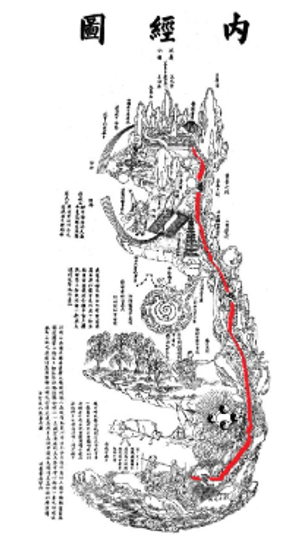
Chart for the Cultivation of Perfection
Many LHBF practitioners believe the practice of LHBF forms part of the cultivation of micro cosmic energy flow of the body. Indeed the names of the LHBF moves trace the energy flow from the lower Dantian to the crown (Baihui) in the picture below.